
Workers' compensation and personal injury
Know exactly what the medical records show, and where they show it.
Workers' compensation medical review from a nurse who has prepared these cases from the inside, with every finding checked and cited.
- Registered nurse for more than 30 years, with an emergency care background
- Ran the workers' compensation program for a major manufacturer
- Flat fee based on pages received, quoted before work begins
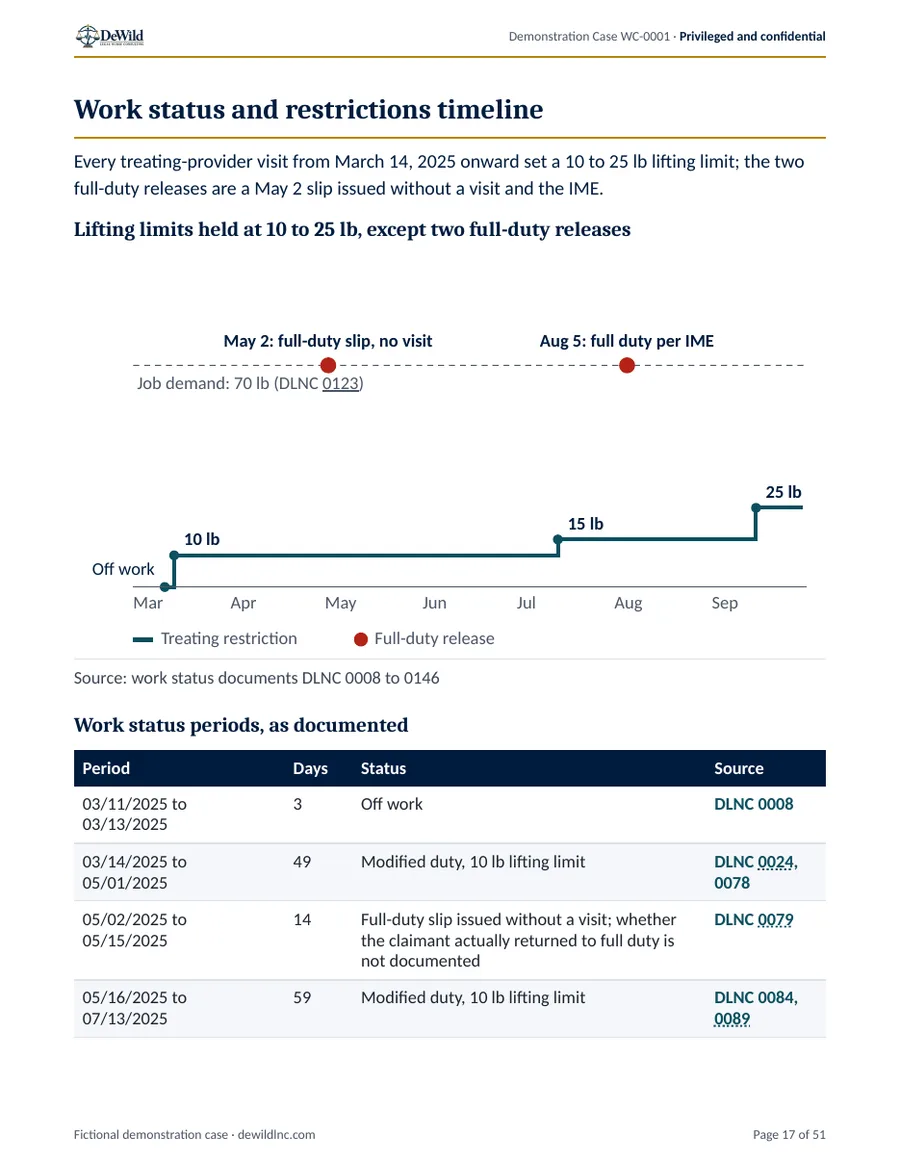
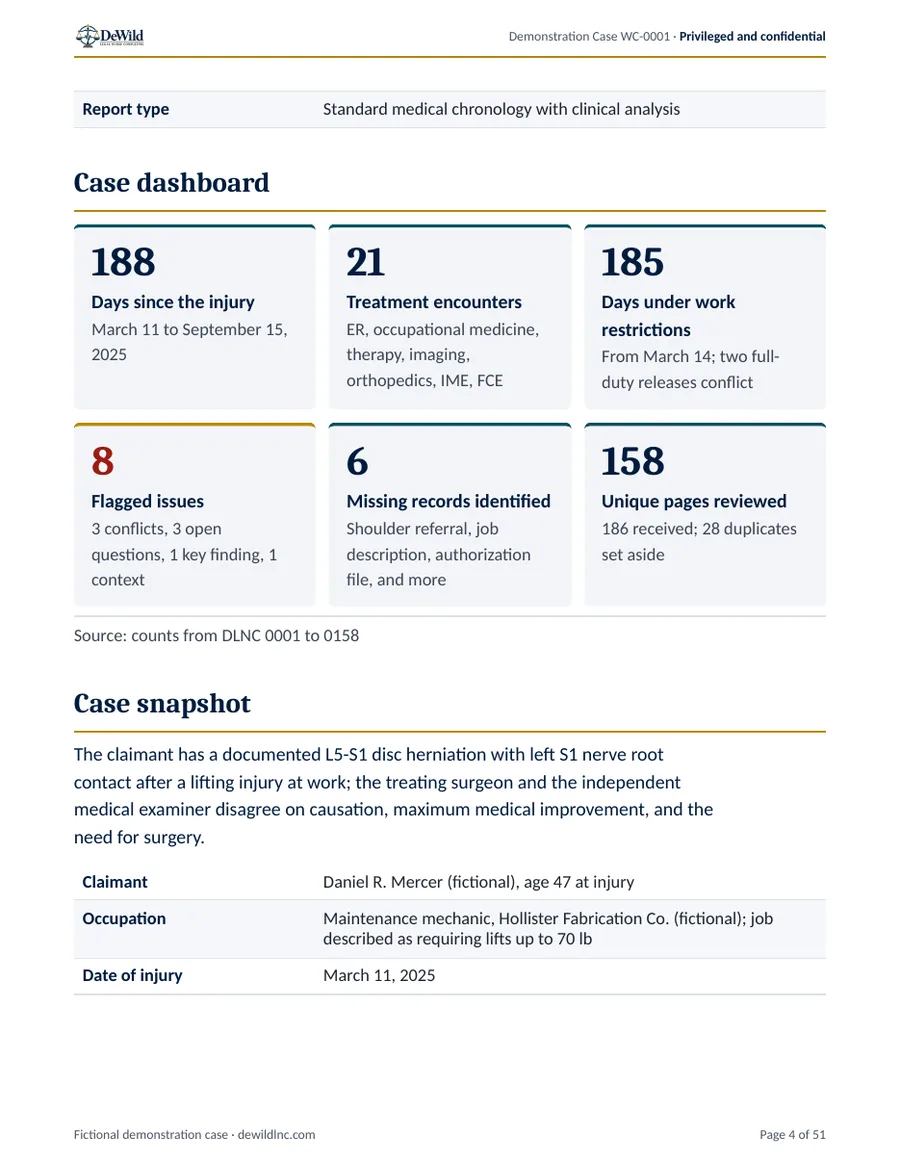
From the sample report · fictional case
The problem
The answers are in the records. Finding them takes days.
A typical claim file arrives as hundreds of pages from a dozen providers, out of order, with duplicates and gaps. Here is what that costs you, and what you get back instead.
Hundreds of pages, out of order, from many providers
One dated chronology with the days between visits computed, duplicates identified and set aside.
The detail that decides the case is in a handwritten note or a work slip
Every flag pulled out, explained in plain language, and linked to the page it came from.
Providers disagree, and it is hard to see on what basis
Treating, IME, and FCE opinions side by side, with each causation statement quoted exactly.
Records that should exist never arrived
A missing records list naming the provider, dates, and record type, ready to request.
Work status changed more often than anyone tracked
Every restriction and release on one timeline, with conflicting releases marked.
A deposition or mediation is coming and the file is not ready
Questions the record raises, grouped by witness, and a rush option at half the turnaround.
What you will know
The questions your case turns on, answered from the record
Each report is built around the questions counsel and adjusters actually ask. The answer comes first, and the page it rests on is one click away.
What happened, and in what order?
A full chronology with a source page on every entry, plus a one-page case snapshot.
Snapshot, chronology
Does the documented mechanism fit the injuries?
How the injury was described in each record, compared with what was found.
Mechanism of injury analysis
What were the restrictions, and when did they change?
Work status periods with day counts, kept separate from FCE recommendations.
Work status timeline
Do the treating provider and the IME agree?
Each opinion laid out with what it relied on: history, findings, reasoning, and certainty stated.
Opinion comparison and foundation review
Was there a prior injury to the same body part?
Earlier complaints and treatment set beside what was documented after the injury.
Before-and-after comparison
Is the FCE reliable?
Effort and validity measures reviewed, and capacity compared with the reported job demands.
FCE validity review
Where are the gaps in care?
Every interval over 30 days during treatment, with the follow-up that was ordered.
Gaps in care
What is missing from the file?
Referrals with no records, expected claim documents, and illegible or undated pages.
Missing records and record quality
How this review is different
Built by someone who has had to use these files
Many services can produce a timeline. What matters is whether you can rely on it when the case gets hard.
Inside experience
Prepared from the inside
I ran a workers' compensation program for a major aluminum manufacturer and worked with the insurance carrier and legal counsel to prepare cases for deposition, mediation, and trial. I know what counsel needs from the medical evidence at each stage, because I had to supply it.
Specialty
Workers' compensation is the specialty
Work status at every visit, restrictions against job duties, MMI and impairment ratings, FCE effort and validity, and authorization delays are tracked as standard, not added when someone thinks to ask.
Accuracy
Conflicts are flagged, never explained away
When two records disagree, the report shows both, cited to their pages, and leaves the judgment to you. Nothing is smoothed over to make the story read better.
From the sample: two full-duty releases conflict with ongoing restrictions. The report marks the conflict and cites each record instead of choosing one.
Accuracy
No claim stronger than the record
Every finding is checked against its source page before delivery, and wording matches what the record actually documents.
If the only source is the claimant's own description, the job requires reportedly requires lifting 70 lb.
The report
Complete enough to work from directly
Not a list of visits. A case file you can hand to an expert, prepare a deposition from, or use to decide whether to settle. These pages come from the fictional sample case.
52
pages in the sample report
77
citations that open the exact record page
28
duplicate pages found in 186 received
6
missing records identified to request
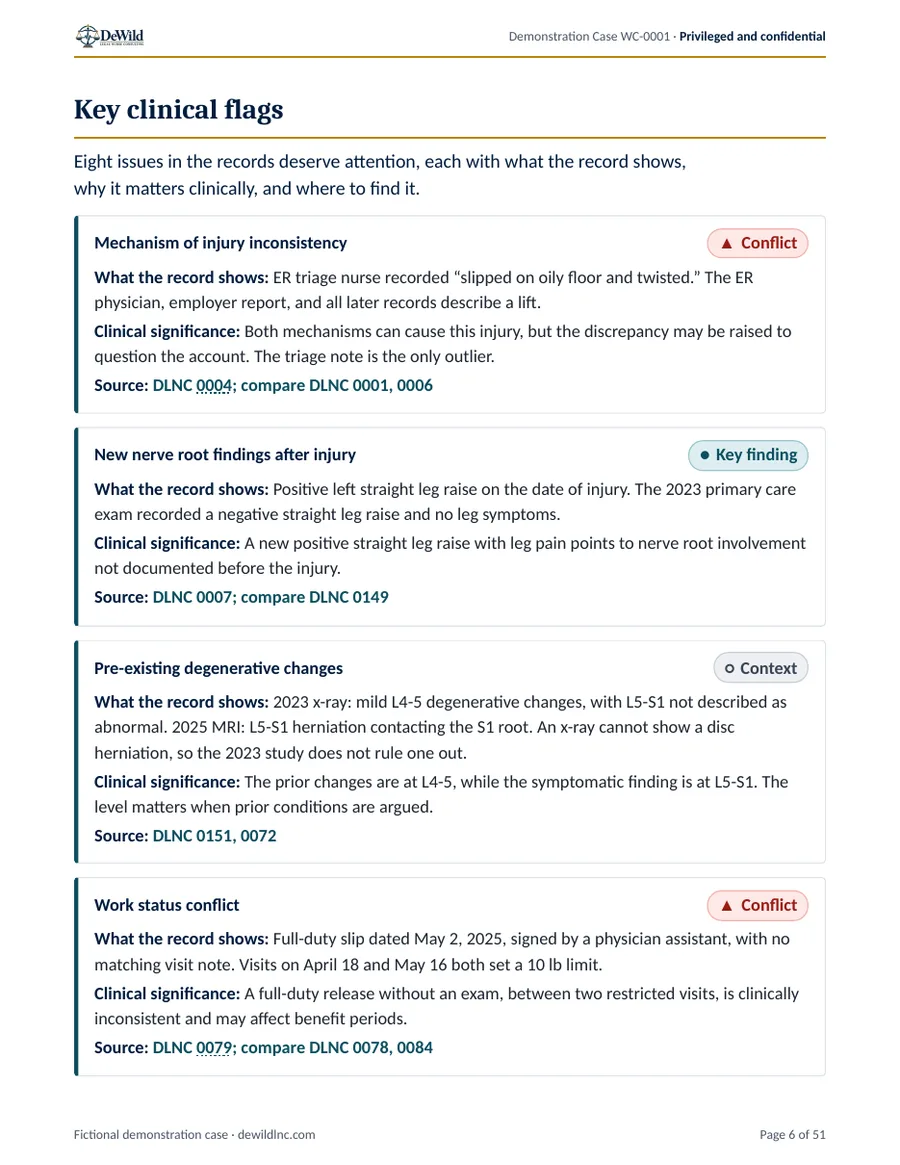
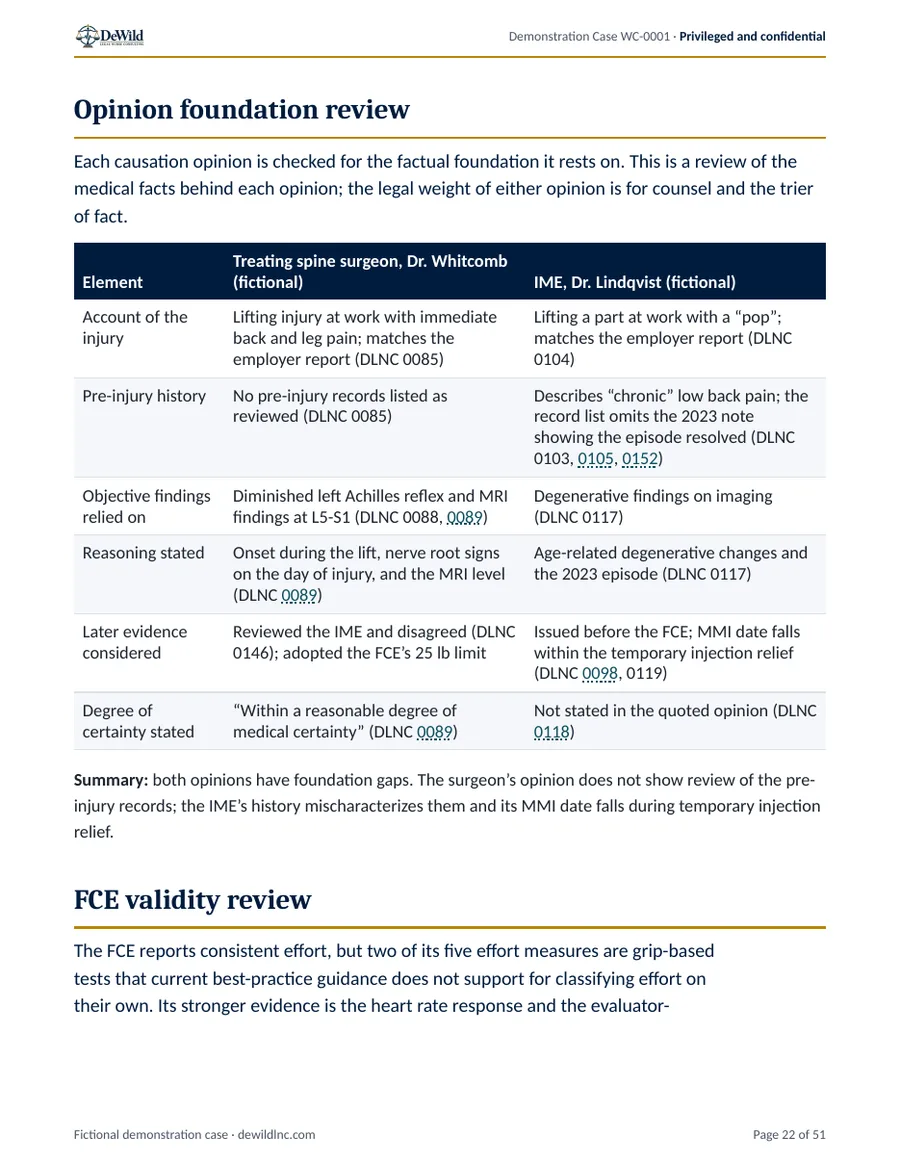
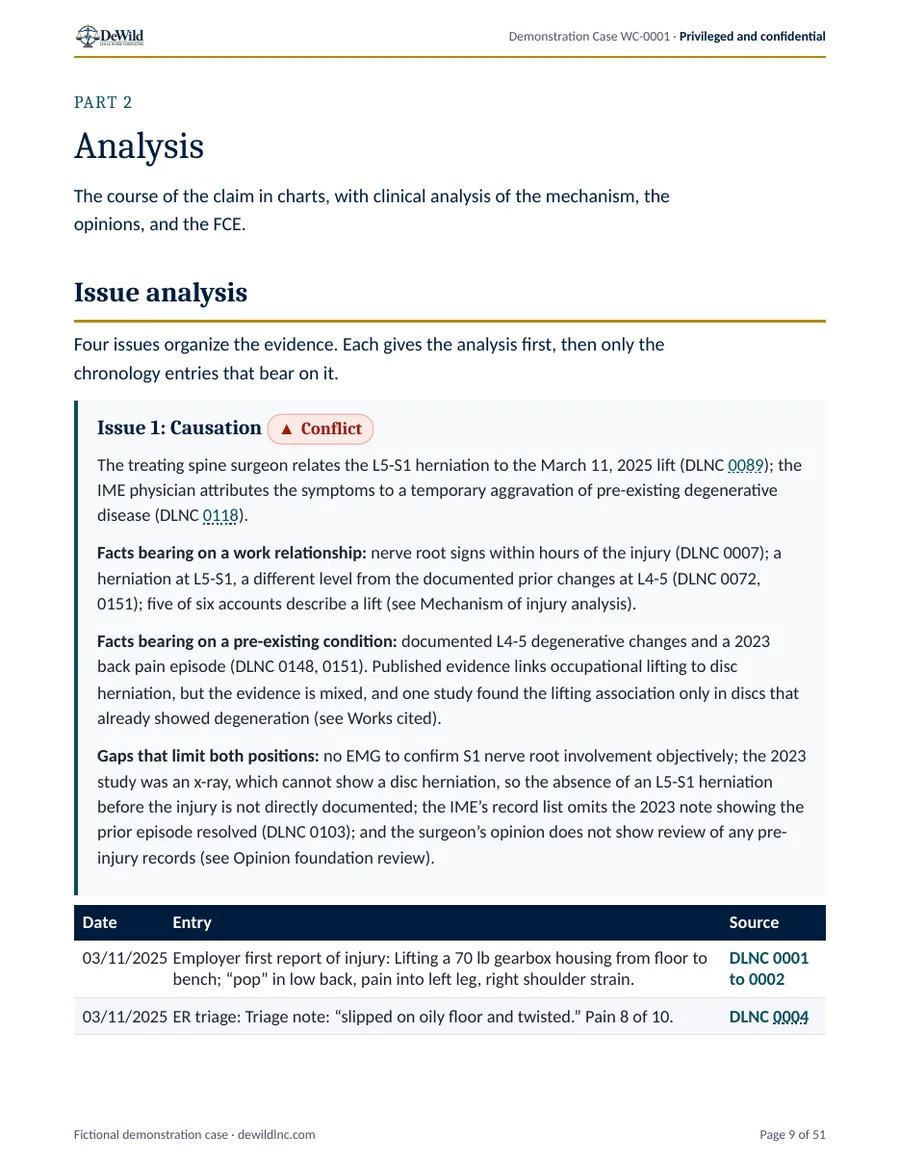
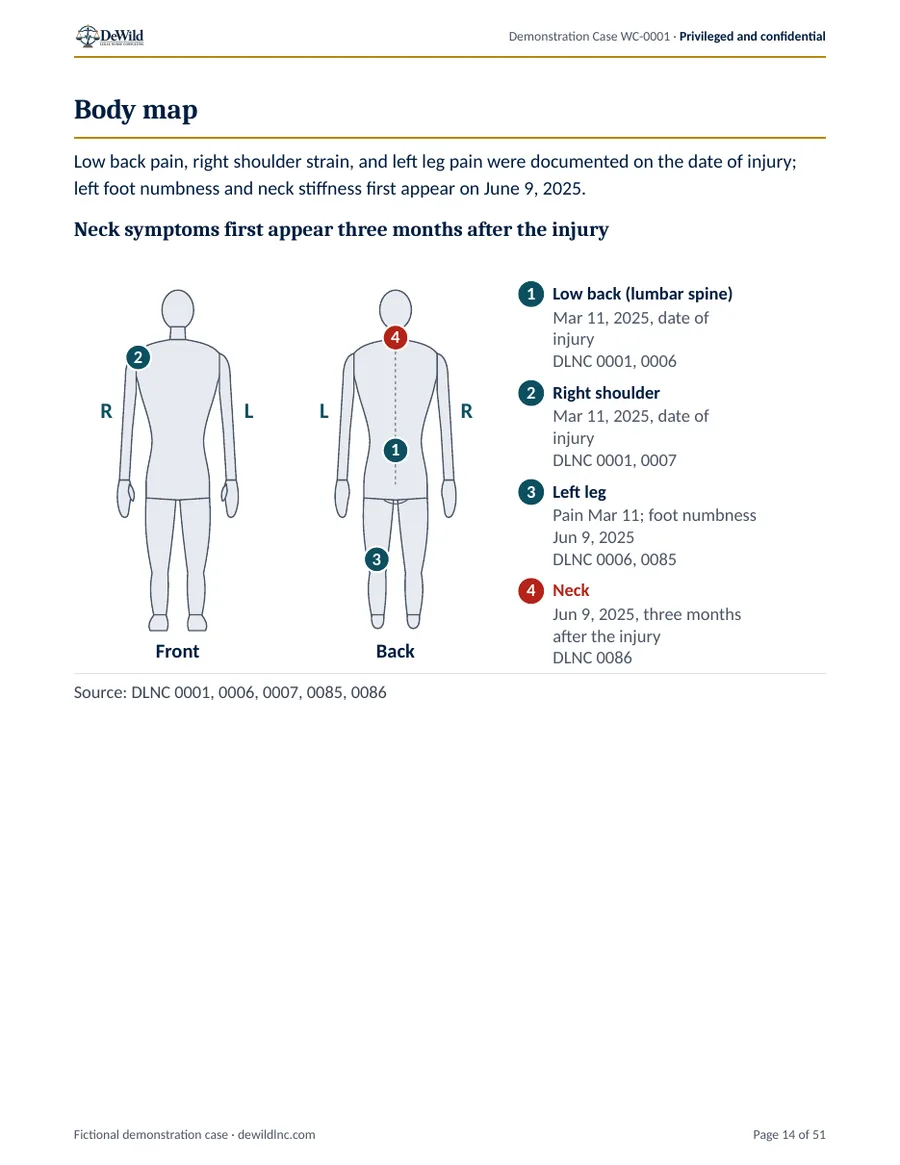
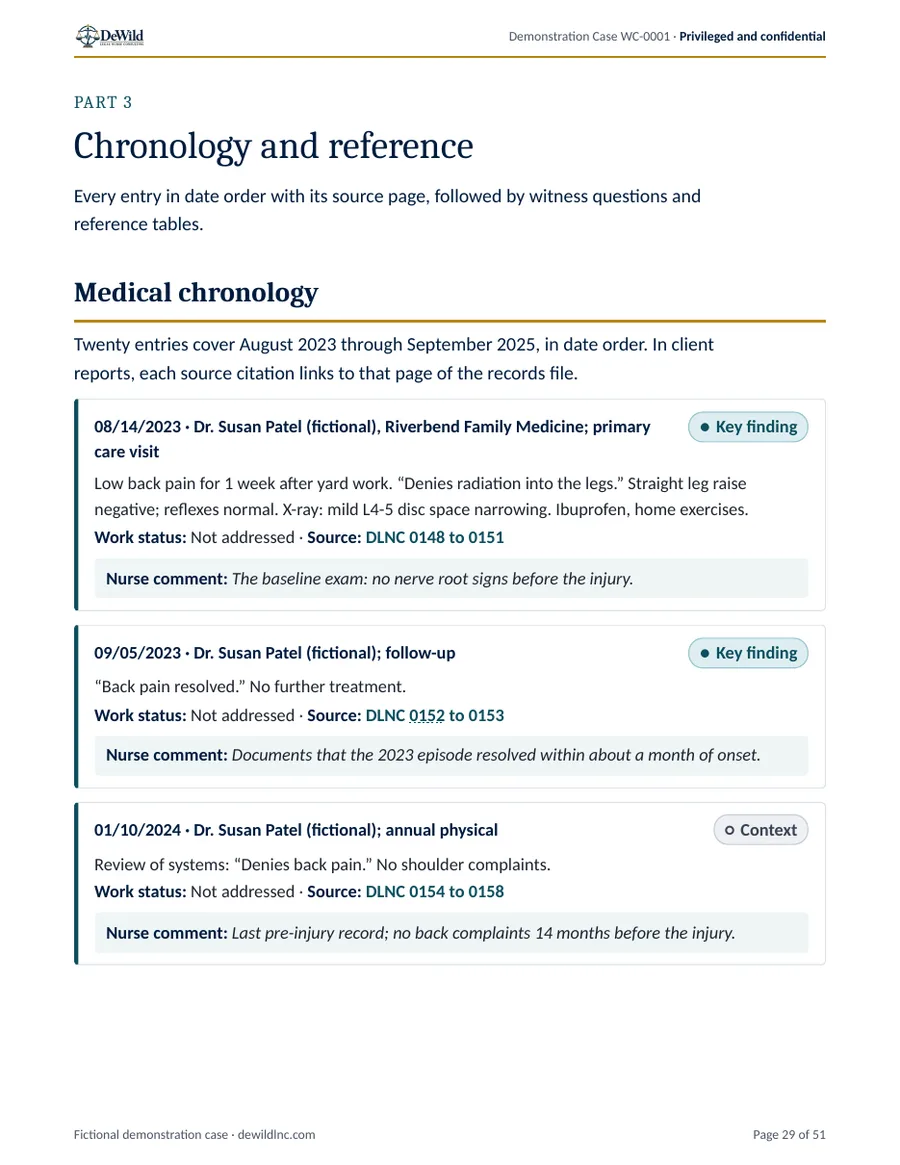
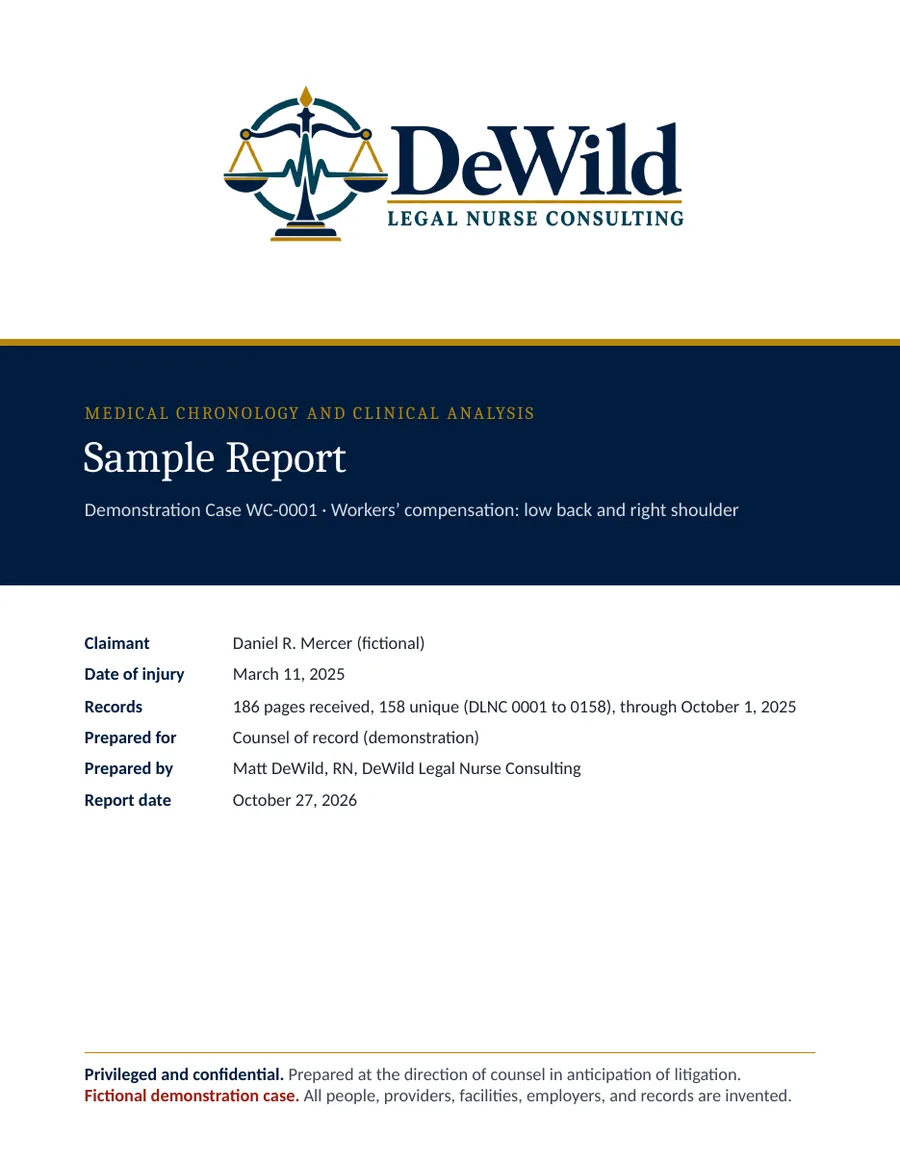
Swipe to see more pages.
Every report includes
- One-page case snapshot
- Case dashboard
- Key clinical flags, plus what was screened with no finding
- Issue analysis with a chronology per issue
- Mechanism of injury analysis
- Body map, front and back
- Treatment timeline by provider
- Pain trajectory, recorded and reported values kept apart
- Before-and-after comparison
- Medical opinion comparison
- Causation statements, quoted exactly
- Opinion foundation review
- Gaps in care
- Missing records and record quality list
- Recovery and risk factors, as neutral context
- Recommended expert review
- Questions by witness
- Full chronology with nurse comments
- Provider directory and diagnoses as documented
- Diagnostic studies and medication timeline
- Glossary in plain language
- Works cited, including evidence that cuts both ways
- Linked records appendix
- Sortable chronology spreadsheet
Added for workers' compensation
- Work status periods with day counts
- Capacity compared with job demands
- FCE validity review
- MMI and impairment rating analysis
- Medication work and safety relevance
- Authorization and utilization review timeline
▲ Conflict ? Open question ● Key finding ○ Context
Free sample report
See the report before you hire me
A complete workers' compensation report built from a fictional case: the case dashboard, clinical flags, issue analysis, charts, an opinion foundation review of the treating surgeon and the IME, and a full cited chronology. The 52-page PDF arrives in your inbox within minutes.
- Lumbar disc injury from lifting at work, with an IME that disagrees with the treating surgeon
- An FCE result set against a reported 70 lb job demand
- Every finding linked to a page in the appendix
Send me the sample report
Fictional demonstration case. I will send the report and a few short follow-up emails; you can unsubscribe at any time.

About
Thirty years of reading what happened to injured people
I have been a registered nurse for more than 30 years. In emergency care, I assessed injuries as they came through the door, so I know what a mechanism of injury should produce, how treatment typically progresses, and when the findings do not fit.
I also led the occupational health department for a major aluminum manufacturer, where I managed its workers' compensation program. That covered the full life of a claim: initial injury care, work restrictions, modified duty, return to work, and case outcomes.
In that role I worked with the insurance carrier and legal counsel to prepare complete case files. I obtained the records, organized them into chronologies counsel could use, and reviewed them for errors, discrepancies, and inconsistencies. I know what happens when something in the record has been missed.
I also have direct experience with functional capacity evaluations: how they are performed, how effort and validity are measured, and how results become work restrictions.
30+ years
Registered nurse
Emergency care
Front-line injury assessment
Workers' comp
Ran an employer program
Case preparation experience
- Obtaining and organizing complete medical records
- Building chronologies counsel can work from directly
- Finding errors, discrepancies, and inconsistencies
- Clinical insight on injuries, treatment, and outcomes
- Medical and legal research in support of counsel
- Preparing cases for depositions, mediation, and trial
How it works
From first call to finished report
- Talk it throughA 15-minute call about the case, the page count, and your deadline. I run a conflict check before we discuss any details.
- Flat-fee quoteYou receive a fixed quote within one business day. It does not change once quoted.
- Secure uploadAfter the engagement letter is signed, you upload records through an upload-only link. Never by email.
- Report and walkthroughThe report arrives on schedule, with a call to walk through the findings and one round of revisions.
Pricing
A flat fee you know before work begins
Priced on the pages you send, so you can check the count yourself. No hourly billing and no surprises.
Case screening
$500 from
- Up to 300 pages
- Snapshot, key issues, and clinical flags
- About 5 business days
Standard chronology
$1,250 from
- Up to 500 pages
- The full report described above
- About 10 business days
Complex chronology
$2,500 from
- Up to 1,000 pages
- $200 per additional 100 pages
- Turnaround quoted per case
Medical research
Quoted per project
- Published medical evidence
- Mechanism of injury analysis
- Written summary with citations
Rush turnaround is available at half the standard time for an additional 50%. A retainer is due when the engagement letter is signed, and the balance is invoiced on delivery. Fees are never contingent on the outcome of the case.
Confidential and secure
Your files are handled like patient records
- Conflict check before every engagement
- Records arrive through an encrypted, upload-only link, never email
- Stored only on services covered by a business associate agreement
- Retained through counsel as a non-testifying consultant
- Records deleted at case close, according to your instructions
Questions
Frequently asked questions
Do you work with both claimants and defense?
Yes. I work with claimant and defense firms, carriers, and claims administrators. The report describes what the record shows, not who it helps, and a conflict check comes before every engagement.
Do you testify as an expert witness?
No. I work as a non-testifying consultant, retained through counsel. My role is to review and organize the medical evidence and provide clinical insight that supports your case preparation.
Do you work with clients in my state?
Yes. All work is done remotely, and I serve attorneys and claims professionals nationwide. Reports use your state's terms and impairment guide edition.
How is the price calculated?
Record review is a flat fee based on the total number of pages you send, including duplicates, so you can check the count against what you sent. Research projects are quoted individually. The price does not change once quoted.
How quickly can you deliver?
Case screenings are typically delivered in about 5 business days and standard chronologies in about 10. Rush service is available at half the standard turnaround for an additional 50%. If you have a firm deadline, tell me on the call.
How do I send the records?
After the engagement letter is signed, you receive a secure, upload-only link. Please never send records by email or through this website.
What if the records are incomplete?
Most record sets are. Every report includes a missing records list showing the provider, dates, and type of record that should exist, so you can request them. When more records arrive, the report can be updated for a quoted fee.
Are revisions included?
Yes. Every entry is checked against its source page before delivery, and each report includes one round of revisions and a walkthrough call.
Do you handle personal injury cases?
Yes. Personal injury reports add a daily-life impact log, treatment reasonableness, future care needs from the records, and an optional medical bills summary.
Have a file on your desk now?
Book a 15-minute call to talk through it before you send anything. You will know whether a review will help, what it will cost, and when you will have it.
Or email matt@dewildlnc.com. Please do not send medical records by email.